November 16, 2005

Pilgrim's Progress

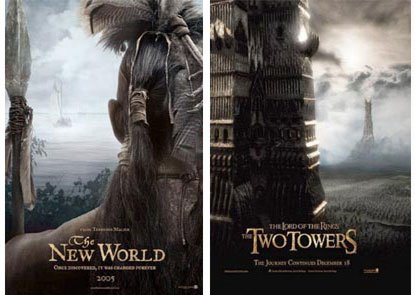
First New Line tries to subliminally affiliate The New World with the middle cow in their cash herd; then they show even less inspiration with their final one-sheet (below), which I thought was fan art when it first showed up online.

You know you're living in anti-intellectual times when the poster for a Terrence Malick movie is identical to that of a Dakota Fanning weeper. Remember the good old days (of Heaven)?

November 15, 2005

Heaven and Hell

Like sleep, or cocaine, the more movies I see in a short period of time the more I tend to want to watch something recreationally so as to cleanse the palate between tastings, so to speak. (You can imagine what the spit bucket looks like this late in the year.) Besides, it’s sort of exciting to find yourself in that groove where movies suddenly all seem ten minutes long (no small boon given stuff like The White Countess and Harry Potter 4) – and the writing on them eases if only for a short while.

Watched Tim Blake Nelson’s Eye of God for the fifth or sixth time, spurred on by the use of the Abraham/Isaac story in the ridiculous The Bee Season which also opens Nelson’s picture, to be impressed anew by its sense of quiet, by its tremendous cast (anchored by the great Martha Plimpton in her definitive role and national treasure Richard Jenkins), and by its clear-eyed vision that smoothes the wrinkles in time it offers in its narrative. I’m haunted by a moment when a boy played by Nick Stahl finds something on the ground and grips it so hard it takes four grown men to wrestle it away from him – and of the moment that Hal Hartley advised Nelson to move to the prologue of the picture, when that same boy turns, the “wrong” way (around to the left rather than right), caught in a car’s headlights: pale, smeared with gore, and struck dumb by something he’s seen. The whole film is about bearing witness, really, and that desire to make some sort of connection. Jenkins’ parole officer tells, piecemeal, he and his wife’s doomed attempts to conceive a child while Plimpton’s resilient small-town girl Ainsley earns a late-night bus-stop reputation for being “a talker” and, thus, to be avoided at all costs. Hal Holbrook is wonderful as a tired sheriff, his voiceover narration at the beginning and end taking on the monumental ennui of M. Emmett Walsh’s from Blood Simple - and so is Kevin Anderson as a man a little too in love with God.

One of the great debuts – it fits comfortably alongside other such modern Southern Gothics as Lone Star and One False Move.
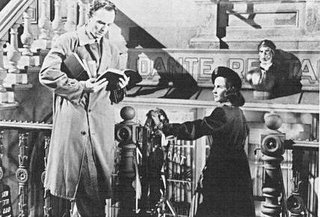
Also took another spin around Mark Robson’s Val Lewton-produced noir inversion The Seventh Victim. Starring Kim Hunter as Mary, a few years before her Oscar spin as Stella in Kazan’s Streetcar Named Desire, it locates her at the center of the typical noir set-up which, in 1943, was still in its stem-cell stage on film (The Maltese Falcon tipping many of the elements of the popular formula two years previous) – the femme fatale, then, becomes her contact in the big city, lawyer Gregory Ward (Hugh “Ward Cleaver” Beaumont), an acquaintance (no fair telling how) of Mary’s missing sister.

Given a miniscule budget and a title as was RKO’s habit with Lewton, the original story was to have been a woman-in-peril piece the twist of which being that she was also the gumshoe – something like a D.O.A. conceit, I guess, in which her failure to solve whatever would result in her becoming the title’s (and the killer’s) seventh victim. What evolved from that is a story of Mary, pulled from a creepy parochial school (she’s warned never to return by a nervous secretary), and thrown into the turmoil of the big city where it’s revealed that the object of her sister’s disappearance is a very genteel social club comprised entirely of earnest Satanists. A precursor to Rosemary’s Baby in its scenes of smoking-club devil worship (the grotesques, the aged and the subtly crippled), it also prefigures Psycho’s shower scene with a silhouette of a woman in a hat (that looks like horns, naturally) menacing poor Mary in the shower. The best scene of the film, however, involves Mary’s hiring of a private eye, the corpse of whom she later encounters in a most unusual way. The Seventh Victim, despite its supernatural trappings, is really more noir than typical Lewton horror and has, I think, been regarded as spare parts as a result – but it’s prime for rediscovery. Its ending, in particular, is the sort of thing that we would never, ever see today: a bleak, almost nihilistic series of images and dialogue that suggest that it isn’t just that there’s no love in the naked city, but that there’s no possibility of it, either.

Robson, like Robert Wise, was an editor for RKO before getting his big break with Lewton – he would go on to helm Ghost Ship, The Isle of the Dead, and, finally fully hitting his stride, Bedlam, with Lewton, before going on to helm a few fairly dreadful big-budget war and bodice ripper flicks. Best known today for Peyton Place, Robson’s peak came more than a decade earlier – and his impressive four-film cycle with Lewton begins here.

November 14, 2005

Notes from the Trenches

A hard week: only part of it due to the workload.

Fourteen screenings this week – that’s four days with three screenings/day and one with two – plus one interview with personal hero Neil Jordan that precluded a fifteenth. The showing for Jim Sheridan’s Get Rich or Die Tryin’ was attended by a minimal-capacity crowd, rowdy and unhappy not for having to go through the usual security gauntlet but having to share space, I think, with two armed and uniformed policemen. There’s a matter of consent (and I’m not talking about willful consent necessarily, but tacit or even unconscious) in situations like this sometimes. I saw a sneak of Candyman in college at the school’s largest auditorium and the entire football team was in attendance (at the University of Colorado at Boulder, almost the only black students are the football players) - when a black cleaning woman made an appearance in the film, that section of the audience erupted into hoots and jeers. As a relatively young, relatively stupid man, I learned a fairly valuable lesson about a lot of the images pushed in our culture that I was not conscious of being offensive – for me, that the cleaning woman was black was an “of course she is” – and for the black audience I was seeing the film with, that she was black was an “of course she is.” I think that kind of consent has a lot to do not only with why almost no professional critic in the United States comments on things like that, but with how audiences respond to riot police being preemptively deployed to a screening of a film about a black rapper who, I guess, owes at least part of his fame to being shot three times.
There was a murder in the lobby of a theater showing this film this weekend, the Loews Cineplex in West Homestead Pennsylvania. Read about here at The Hollywood Reporter, and though the theater has admitted that they have not been able to establish a direct connection to the film (the victim is a 30-year-old man who got into an altercation waiting for the bathroom – not exactly the typical gang-banger stereotype, but what do I know), Loews has decided to yank the picture from their lineup regardless. Here’s what else is showing a the Cineplex: A History of Violence, Capote, Chicken Little, Derailed, Doom, Dreamer: Inspired by a True Story, Flightplan, G, Good Night, and Good Luck., Jarhead, Kiss Kiss, Bang Bang, North Country, Prime, Saw II, Shopgirl, The Legend of Zorro, The Weather Man, Wallace & Gromit and Zathura.. You can probably let Shopgirl, Prime and Good Night and Good Luck. off the hook, but the rest of the pictures are at least hyperkinetic and at worst (Saw II, Kiss Kiss, Bang Bang, Doom, Derailed) actually in love with bloodlust.

Derailed, especially (sharing the same weird “gather ye rosebuds” message as Saw II, oddly enough), is woefully nihilistic and packed with disturbing imagery – more so, I’d say, than Get Rich or Die Tryin’. But Derailed is only about a white guy killing without consequence to protect his wife and his mistress from a French ponce and a black thug (played by a rapper – the white guy’s black guy is also played by a rapper, incidentally) – while Get Rich or Die Tryin’ is a rather boring biopic about the idiotic rise of a black rapper whose success is mostly owed to chest-pounding, and pointing out the same sort of darkie menace-hysteria and feckless racism as has accompanied the opening of his film. He’s made a mint, in other words, by being a racist prick rhyming about other racist pricks – ain’t the world a complicated place?

In any case, I felt miserable and depressed during the show – with no reason to believe that it had much, if anything, to do with the film itself, I felt like it wasn’t fair to write on it until I have a chance to see it again.

Besides the flicks I’m on the hook for already, also saw Walk the Line and Harry Potter 4 - neither of which blew my skirts up though I liked the Cash biopic a little tiny bit better than I liked the Potter. Joaquin Phoenix is very good (so is Witherspoon) but to what end? Here’s the drill, say it with me: childhood-struggling early adulthood-singing-big break-marriage-drugs-groupies-singing-divorce-drugs-singing-reconciliation-rehab-singing-end titles-end credits. Here’s one-fifth of the nominees for Picture, Actor, and Actress, though, all in one place in any case and almost by default, so if you want to get a head start on looking at the films Oscar gets a woody for this year, here’s your chance. In all likelihood, however, the best picture noms are films that we haven’t seen yet (or aren’t finished): Syriana, Munich, Match Point, Memoirs of a Geisha, King Kong, The Libertine, and so on. If you think, like I do, that Oscar is a load of incestuous bullshit – consider that I’d be hard-pressed at this point to name more than one or two mainstream films that even have a chance of cracking my top-ten so far when all’s said and done (and is History of Violence even a mainstream film?). First time that’s happened in five years or so this late in the year. Fingers still crossed for King Kong, though. Three hours with a big monkey and a T-Rex and Naomi Watts? Sounds like picture of the year material to me.

Anyone taking bets on how Spielberg will provide Munich with a cozy, familial, happy ending?

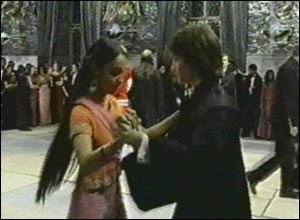
For Harry Potter, well, it’s the first time that I’ve been bothered by the kids’ acting (they took a lot of acting training under Mike Newell’s dubious tutelage, and it shows in their self-consciousness and budding pretention), and it’s the first time that I’ve been bored to tears by it. The scenes don’t so much end as drop off a table to be replaced, clumsily, by more scenes that aren’t edited worth a shit and go on forever. Worst culprit is the formal ball: complete with a band that sings a "wizardy" song with "wizardy" lyrics. Yep. The setpieces are fine, but the series has reverted to looking at special effects. I loved Alfonso Cuaron’s Harry Potter 3 - it makes the fall this time around just that much more precipitous.
The DIFF started this week on Thursday with their gala Red Carpet opening night. The press release is fairly hilarious as was local news coverage that showed first the head of the Denver Film Society, then our mayor, then a group of Japanese industry professionals that no one knew who they were, then some guy who was maybe Claude LeLouch, and then a bunch of bikers from a local Indian Motorcycle club invited to be guests at this $75/ticket (or $250/ticket) screening of The World’s Fastest Indian. Roger Donaldson flew in, I guess, and I have no reason to believe that he didn’t, at the last minute – but I didn’t see him on the “carpet” as it were. Last thing and then I’m most likely done talking about this fest except to give a few blog-exclusive capsules on some of the films we’re not going to bother covering officially, the Film Society this week announced that their plans to join in a renovation of a historic theater in Denver and share the space with a huge bookstore (the venerable Tattered Cover) and music retailer (Twist & Shout) had fallen through.

What I suspect is that the intention was to announce that negotiations on the project (touted for some time as the cornerstone restoration project in Denver’s rundown East Colfax area) had reached a fruitful resolution on opening night – instead, on the day before their 28th festival, news breaks that it’s all come tumbling down. Here’s an article from The Denver Post last week

detailing the struggles to that juncture. Everybody’s saying the right things now – and so they have for almost three decades – which is, you’ll agree, a lot of talking. Fingers are pointing: most of them at the Film Society for having bigger eyes than fundraising capability. The Rocky Mtn. News reports on the fiasco here . What’s the truth? What difference does it make? Something’s rotten in the state of Denmark – and a city the size and education level of Denver should have more serious cinema-culture/educational opportunities for the rest of the year than, oh, next to none.

Quis custodiat custodium? Who's even keeping score, anymore?

Currently reading Frances FitzGerald’s amazing Way Out There in the Blue:

Here’s this week’s capture – (2.2) – winner last week, Jack S.:
New Reviews:

A capsule for the new Lasse Hallstrom disaster, Casanova , Bill's DVD write-up for the astonishing new War of the Worlds (2005) DVD, and Alex's takedown of poor Monster High.

Hot off the Presses (updated 11/15/05):

Check out Bill's take and DVD review of Ozon's 5 x 2 - a film I missed in its eyeblink tour through Denver (sans critic's screening) and Bill's review doesn't make it much of a priority that I catch it, no matter how tantalizing the description of it as "Irreversible-lite."

Another capsule from the DIFF, this one James Ivory and Kazuo Ishiguro's The White Countess, find in it Ralph Fiennes and Natasha Richardson (and both of the Redgrave girls) in antebellum Shanghai, decomposing in the decadent way of potpourri in velvetine sitting rooms.

Hot off the Presses (updated 11/16/05):

New reviews of Richard Gere going all Kabbalah on our asses in The Bee Season, and Joaquin Phoenix going to a funeral in the suspiciously familiar Walk the Line. Over in capsules, we find Pierce Brosnan and Greg Kinnear take the bull by the horns in The Matador.

One of my favorite reviewers, Duncan Shepard, takes a few of these films apart in ways more eloquent than I'm capable - check it out here if you promise to come back. Especially like the part about 50 Cent being a "two-bit" actor. Arcane, and funny - and true.

Hot off the Presses (updated 11/17/05):

The one you've all not been waiting for: Harry Potter 4.

November 07, 2005

Notes from the Trenches

Hey! Be Your Own Critic at the Denver Film Festival!

Having watched about a dozen films now for the Denver International Film Festival, I’m going to pitch coverage for the site at about ten select capsules with any interviews that I might do there (none through the DFS in any case) going live in conjunction with the official releases of the films in question. DIFF has never attracted much national interest and the extent that we’ve covered it here at FFC has been, I think, mainly Bill indulging my hope that my hometown festival would evolve into a festival for people knowledgeable about film rather than an annual fundraiser (and a wildly successful one) for the Denver Film Society.

Reading an interview (give it a look, a good read written by friend and colleague Robert Denerstein) with DFS president Ron Henderson in this weekend’s Rocky Mtn. News, I was disappointed to see that the emphasis (after the dubious proclamation – and dubious pride accompanying it – that had the DIFF not moved back a month in the year that it wouldn’t have been able to obtain such barnburners as The World’s Fastest Indian and Casanova for its opening night and centerpiece presentations) seems to be that presale tickets to Society members this year more than doubled from the same period of time for last year’s edition. What that makes me feel is a lot of hopelessness and apathy: if the champions of our film culture are going by box office in the assessment of quality – well, yeah whatever – maybe I’m just naïve and it’s always been this way. In any case, give the article a look because even if the DIFF isn’t even a blip on the radar for you (and why should it be?), it’s a pretty fascinating insight into why some festivals soar and why others just sort of wander around.

Two questions and I’m done asking questions: why would fewer people come if the movies were great? and if the audience in Denver is unusually gullible, then who if not the DFS is entrusted to provide educational opportunities for the rest of the year?
Was shut out of a screening of Brokeback Mountain at a festival screening this week by what I’m told is Focus Features because they didn’t want any Internet press to see it. I’m not sure, in that case, how Slate and Salon got to see it (probably why it wasn’t so-restricted at TIFF, which we also covered, oddly enough) - but I do know that what it meant was that I didn’t get to go while people that no one in the critical community has seen at any other screening: ever (calling into question who the hell they are, of course, but it’s not an urgent question), along with a few members of dubious local print outlets with microscopic distributions. Probably just answered my own question - but what’s strangest is that there are no such restrictions (how could there be?) on me attending the closing night presentation of Brokeback Mountain as a civilian guest of the festival. I guess that means that we’re going live with a full-length review of it in a couple of weeks independent of the DIFF (ditto Breakfast on Pluto). Besides, there’s no embargo on this fucker anymore – and what the hell is the point of an embargo, but to allow industry rags like The Hollywood Reporter and Variety first shot? What if everyone threw a mutual admiration party and we didn’t show up?
Oh, right, no more questions.

Also denied an interview with the suddenly media-shy Ang Lee who will, however, be interviewed on-stage by Lisa Kennedy

of the Denver Post. Here’re the ten titles I’ll be reviewing for the site in conjunction with the festival: first, the opening night, centerpiece, and Cassavetes tribute films (World’s Fastest Indian, Casanova, and Duck which have the honor of sharing two stars total between them – it occurs to me that it doesn’t matter how the two stars are distributed) – then a mediocre Primer-like mindfuck from Switzerland called Absolut; probably Pierce Brosnan’s The Matador; a weird Bugsy Malone-like experiment, but with noir this time, called Brick (Raymond Chandler in high school); probably a Holocaust flick called Fateless; probably Lars Von Trier’s Manderlay and Michael Winterbottom’s Tristram Shandy and most likely either Mrs. Henderson or Duane Hopwood even though the same local freelance publicist who raved about Dreamer, raved about it.

You kid yourself that you’re doing something that matters by covering a minor festival in detail when really what you’re doing is putting people to sleep (and torturing your editor) by talking about bad movies that will most likely never see the light of day. It isn’t that there aren’t good films that don’t get distribution (like almost all of Hao Hsiou-Hsien’s films – or Beat Takeshi’s – or Edward Yang’s), and if I find any, I’ll talk about them – it’s that most films that don’t get distribution are bloody horrible. I mean, Christ, look at what does get distributed. It’s unconscionable that people are charged cash money to see something like Duck (and you wouldn’t be hearing about it from me, either, if it weren’t a major screening at this fest – lambasting indie pics that you will probably never see again in any format is a lot like potting clay ducks) - and that, more, it’s up for an award for new filmmakers offered at DIFF along with the deeply suspect Bittersweet Place (which we reviewed at the Tribeca Film Festival).

It’s not that most anyone in this audience will feel cheated, it’s that it strikes me as amoral in a way (and bound to backfire sooner or later) when you take your audience so for granted.

Here’s this week’s mystery capture (Contest 2, Capture 1/7) – The Captain has graciously offered to sit this one out (and I accepted that offer initially) – but, you know what, that’s ridiculous – he’s the king right now, and what fun is it if there’s no one to knock off the hill? Fair game, in other words, all in – let’s start with an easy one from one of my favorite pics:

Hot off the presses - updated 11/09/05

The first of my DIFF caps, this one Philip Baker Hall's jaw-dropper Duck

Travis talks about big swords in Blue Underground's new double-dipper of Fire and Ice
I talk about Jennifer Jones' embalmed and melted to Rock Hudson in A Farewell to Arms
and Travis again about Hayley Mills and Hayley Mills 2.0 Parent Trap I & II

Also, absolutely do not miss Bill's thoughts on Fox's new (hopefully short-lived) practice of defiling review copies of their screening DVDs. (Scroll past the Mr. and Mrs. Smith review to get to the chewy goodness.) Not the smartest move, says common sense, and Bill's articulate outrage starts a conversation we all should be having.

Hot off the presses - updated 11/10/05

Joe Wright's almost post-mod Pride and Prejudice is better described as Impressionistic, I guess - but no great loss, it not being meta, as, having seen Michael Winterbottom's Tristram Shandy and Shane Black's Kiss Kiss Bang Bang, there's no paucity of po-mo epics in the pipeline.

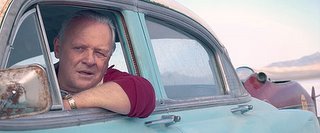
In DIFF news, an old Anthony Hopkins rides an old motorcycle across the Bonneville Salt Flats. But not before spreading his pixie dust over a collection of stock sad-sacks in Roger Donaldson's The World's Fastest Indian.

Also check out a little blather about a little pittance: Marcus Nispel's Frankenstein: a failed pilot for an ill-conceived USA Network television series. Main miscreant responsible? Dean Koontz. Millionaire. Idiot.

Hot off the presses - updated 11/11/05

Not going to write on the Jim Sheridan/50 Cent pic because I need to see it again. Audience I saw it with was awful and, more, for the first time ever it was presided over at either entrance by two armed policemen in full uniform (in addition to the usual security retinue). Yep, it's racism. Distracting and, worse, a self-fulfilling prophecy - lots of unpleasant anxiety in the air and I found myself not able to concentrate for long stretches. It didn't seem like it was worth a shit, but I want to be sure.

Here, however are new reviews for Derailed: Jennifer Aniston's attempt to break into mainstream flicks by slutting it up a little, tiny, bit. Am I alone in thinking that Aniston's sexuality is so bland and chaste that she couldn't get a rise out of a ten-peckered owl? In any case, she's so bad in this film that she sort of undermines it - what there is to undermine, that is. Also a review of Shane Black's Kiss Kiss, Bang Bang: a film that's easy to hate. But I didn't.

On the festival circuit, find a capsule for Michael Winterbottom's Tristram Shandy: A Cock and Bull Story.

Travis, meanwhile, throws down the gauntlet before Jerry Lewis' entire filmography - or as much as he can stand.

November 06, 2005

Lewton Family Val-ues, part two


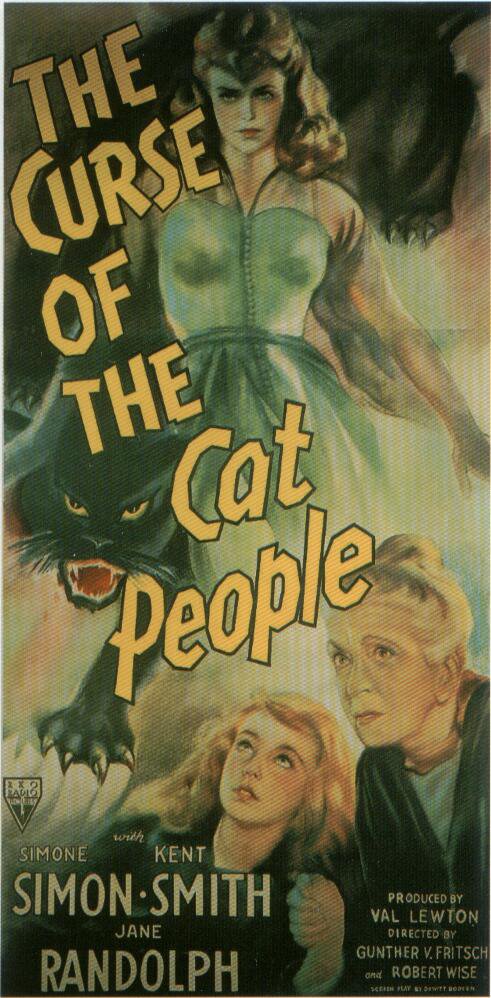
After cutting his teeth at RKO as an assistant editor (progressing on to being Orson Welles’ editor on Citizen Kane and The Magnificent Ambersons) Robert Wise was given a shot at directing a couple of low-budget creepers for Lewton: the astonishing Curse of the Cat People (where he’s billed as co-director with Gunther von Fritsch though von Fritsch was dumped from the production fairly early on – what you see is basically Wise and Lewton) and the somewhat more conventional (and only partially successful) The Body Snatcher. Open Curse of the Cat People with a kindergarten class wending their way through a path in Sleepy Hollow; an anxious children’s game; and a creepy little girl Amy (Ann Carter, more Martin Stephens than Dakota Fanning) strays from the path and befriends a butterfly that a well-meaning playmate promptly crushes. She slaps him, of course, and we’re pushed into the claustrophobic confines of the true progenitor of The Sixth Sense (a film that progressively falls apart the more Shyamalan’s childish direction and inexplicable skylarks are put under the microscope – worst is probably the bully comeuppance in a film that has essentially been a sanctuary for lost children)*: a piece about the secrecy of the cult of childhood and the terror of parents who no longer recognize their children in the wild, overgrown, out there. It’s one of the finest evocations of childhood as a hallucinatory maze through which kids wander alone. Amy is freaky, no question, hearing voices from the witches house (and receiving gifts) and wishing for a friend that manifests itself as the possibly psychotic ghost (Simone Simon, reprising her role) of her daddy’s first wife - but the real anxiety of the piece is in her parents wondering if madness is congenital - and if lines of communication allowed to founder can ever be repaired.

Smothering and nightmarish from start to finish, the film erects a dreamscape patched together all of fairy tales and suggestion – enough so that a late scene of carolers takes on the confused dread of exorcist Merrin showing up at a certain Georgetown brownstone. It’s a flat brilliant film – more sustained, certainly more sophisticated than its predecessor – with our Amy dressed throughout like Lewis Carroll’s Alice, staring out from the warmth of her family’s bosom into the cold and her dead friend who doesn’t seem to want to talk about where she’s from, or where she might be taking her. Fans of Wise’s The Haunting will find many of the director’s hallmark use of camera angles, triple-dissolves (a Lewton standard), sound design, deep focus, and explosion of mirrors, both here and in Wise’s next Lewton picture, The Body Snatcher.

Paired with Boris Karloff, Wise undertakes Robert Louis Stevenson’s grim little ditty about the acquisition of cadavers for medical use, inspired, perhaps, by notorious grave robbers (and Stevenson contemporaries) Burke and Hare. The highlight of the piece probably Karloff’s grim, maniacal Mr. Gray: a cat person, of course, in this Lewton production, a dog meets an untimely end in only one of a myriad shocking things, and suggestions of things, in the piece. But it doesn’t cohere in the same way as many of Lewton’s others – mainly, I think, because it never provides a baseline for its characters’ behavior and so it’s a collection of lunatics rubbing up against each other in a moral vacuum. Probably the point, the film falls into camp long about the time Bela Lugosi makes a useless cameo – it’s not a disaster, but it’s not a masterpiece either and the bar has been set high. A shame that a proposed collaboration between Wise and Lewton on Sheridan le Fanu’s “Camilla” never had a chance to come to fruition.

*Hitchcock’s Marnie also owes a debt to this picture in its horrible look at madness and jealousy between a doddering old woman (possibly a witch) and her daughter who, despite appearances, the lady maintains has died “long ago”. Should also mention a lot of the landscapes of Burton’s Corpse Bride as finding seed here.

November 03, 2005

Top 10 of 1999


Inspired by Ed Gonzalez's ongoing 10-best project over at Slant, and seeing as how 1999 is the one year in FFC's history for which there is no list on file, I hereby announce with spectacular punctuality my Top 10 of 1999:

1. Eyes Wide Shut (d. Stanley Kubrick)

2. The Straight Story (d. David Lynch)
3. Being John Malkovich (d. Spike Jonze)
4. Bringing Out the Dead (d. Martin Scorsese)
5. The Blair Witch Project (ds. Daniel Myrick & Eduardo Sánchez)
6. Ravenous (d. Antonia Bird)
7. Beau Travail (d. Claire Denis)
8. Election (d. Alexander Payne)
9. Titus (d. Julie Taymor)
10.American Movie: The Making of Northwestern (d. Chris Smith)

Honourable Mentions: The Insider; The Ninth Gate; The Iron Giant; eXistenZ; Rosetta; Human Resources; Fight Club; Summer of Sam; The Limey; Toy Story 2; Sweet and Lowdown
Blind Spots: Ghost Dog: The Way of the Samurai; L'Humanite; The Wind Will Carry Us


Yours?

October 30, 2005

Notes from the Trenches


The year winding down means, later than usual this time, the curious Denver International Film Festival: a city festival misidentified in The Denver Post as a “regional” festival (I don’t know of anyone caravanning down here from Aspen much less the out-of-state “region”), and one that seems for whatever reason to emphasize volume over quality. I don’t think it’s a philosophical problem, not entirely anyway, but you have to believe that they have a harder time than some other, sexier festivals in getting titles.

When they first started 28 years ago now, Sundance was nothing, Telluride was in its infancy. . . in fact, before the anti-homosexuality Amendment 2 passed in Colorado, I seem to remember Redford mulling the Mile High City as a home for his now-monolithic fest – what I’m saying is that there was an opportunity for the DIFF at the beginning to carve their own niche (much like Aspen has with their spectacular shorts fest – or Vail, in only their second year, with gaudier stars earlier in the year). What’s happened though, I fear, is that in trying to compete with festivals that indeed found a fertile plot in which to plant themselves, the DIFF has tried to be all things to all people and, in the process, become almost like an afterthought while their peers thrived.

Where Telluride has the advantage of offering unofficial first looks in an (allegedly) non-industry setting (it’s slipping a little – I do wonder if in a couple of years, the last vestige of their elite philosophy is going to be a continued unfriendliness towards the press) – they promise not to divulge their films ahead of time in a weird handshake deal that guarantees them films with the semantic contract that those films’ North American “debuts” will still be at Toronto – and Aspen and Vail have the advantage of being ski resorts that are home away from home for talent and their guests. The problem as I always thought of it for Denver was that it (in October – they used to be in the Spring) was competing against Venice, New York and the Hamptons while being, most years, just a few days after Toronto.

Hence the move this year away from crowded October to the relative doldrums of November – its closing night just a few days before Thanksgiving. It’s the struggling sports franchise that finally decides to burn the house down and start again at the foundations. I wonder at the timing of this reorganization, though, because last year’s fest had reasonably strong films with guests like Morgan Freeman, Kevin Bacon, Jamie Foxx & Taylor Hackford, Albert Maysles and so on. In any case, the move hasn’t seemed to have helped in attracting prestige festival films and top-line talent that I think event organizers had hoped that it would.

Though the three featured pictures (Opening Night, Centerpiece, Closing Night) aren’t pictures that are going to open the Friday after their Thursday festival debuts (as White Oleander was a couple of years ago, and The Human Stain last year. . . was it last year? no, two years ago, last year was Ray - eh, who can remember) – none of them save, perhaps, Ang Lee’s Closing Night Brokeback Mountain are pictures that I was particularly interested in seeing. The new Anthony Hopkins flick The World’s Fastest Indian opens the fest (sans Hopkins who did show up in Denver for a festival once, but incognito and in a leather bar on Broadway nowhere near the festival’s venues. . . or so local columnists claimed) and the new Heath Ledger (the other new Heath Ledger) Casanova is the centerpiece presentation. The trailer looks dreadful which, I guess, is better than non-descript.

I’m sort of vaguely interested in the Eugene Jarecki documentary – and sort of excited to see Bob Rafelson introduce what’s supposed to be a new print of Robert Wise’s The Set-Up (never count prints before they’re projected – there’s been a precedent at this fest for prints arriving with the wrong subtitles, for instance, or not arriving at all and the films being shown on VHS). I always like Michael Winterbottom and his Tristram Shandy is coming (though he is not) – Neil Jordan and Cillian Murphy’s picture (Breakfast on Pluto) is coming (and so is Jordan). The key for me, though, is that looking over the schedule I can honestly say that not a one of them makes me nervous.

The President’s Last Bang is fabbo, sure, another wonderful film from South Korea – but it’s hard not to comment on a few of what seem to be the major omissions:

Park Chanwook's Sympathy for Lady Vengeance
Laurent Cantet’s Vers La Sud
Lucile Hadzihalilovic's Innocence
Michael Haneke's Cache
Sturla Gunnarsen’s Beowulf & Grendel
Steven Soderbergh's Bubble
Phillippe Garel's Les Amants Reguliers
Richard Grant’s Wah Wah
Cristi Puiu's The Death Of Mr. Lazarescu
Shinya Tsukamoto's Haze
Stanley Kwan’s Everlasting Regret
Mary Harron’s Notorious Bettie Page
Song Il-gon's Spider Forest
Eli Roth’s Hostel
Thomas Vinterberg’s Dear Wendy
Abdellatif Kechiche's Games Of Love And Chance (L'esquive)
Takeshi Kitano's Takeshis
Hou Hsiau-Hsien's Café Lumiere and Three Times
Dardenne Brothers' L’Enfant
Terry Gilliam's Tideland
Takashi Miike's The Great Yokai War
Kim Ki-Duk's Hwal
Hur Jin-Ho’s April Snow
Alexander Sokurov’s The Sun
Liam Lynch’s Sarah Silverman’s: Jesus is Magic
Carlos Reygadas’ Battle in Heaven
Baltasar Kormakur’s A Little Taste of Heaven

The tribute this year is to Japanese cinema which doesn’t appear to include new pictures by some of Japan’s top filmmakers (Beat Takeshi, Shinya Tsukamoto, Takashi Miike). Neither does it have a whisper of a Kurosawa (Akira nor Kiyoshi), Kenji Mizoguchi, the recently-deceased Nomura Yoshitaro or Ichikawa Jun’s Tony Takitini which has played everywhere, it seems, except for Denver.

And therein lies the problem for me, I think, because there’s no joy in poking at the DIFF – they’ve asked me to be on their juries (still the only internet-based goon in 28 years that they’ve bestowed this honor upon), invited me to program and introduce a favorite film, and I could honestly say that I like every single person working for the Denver Film Society. But it troubles me that I’ve never read one article vaguely critical about the festival when it occurs to me that if you really care about a thing, you should care enough about it to want it to be better. The silence isn't for a lack of problems, any festival this sprawling has problems – I think that it might be for a lack of respect: I think that we never expect the DIFF to fall too far out of a prescribed range and so just we just keep on keepin’ on, as they say. Then again, on a macro and micro basis (from a critical perspective), there's a whole lot of justifiable "what's the point?"

As for me and my silence, I think I’ve been worried about losing the respect and access that they’ve given me (and injuring my relationships with the people who work so hard on it every year) at the expense of what is, hopefully, the kind of candor and – yeah – anger that earned their respect in the first place. It’s the problem of becoming friendly with that which you’re enlisted to cover – you let it go long enough and you get forgiving about the warts. Worse, though, is apathetic and, until this year, I never was. Ironic.
So, look, I have a hard time wrestling with a festival that boasts of its size and scope (hundreds of flicks, ten days, dozens of countries) in an annual press release, but doesn’t get films like Beat Takeshi’s Takeshis, or the two Hou Hsiau-Hsien flicks that’ve been released since Millennium Mambo (and still don’t have a distributor) – or the new Kim Ki-Duk who, I thought, was at least becoming a critical darling in the United States even if he’s still under the radar for most people. Not even talking about the Dardennes, the Vinterberg, the Gilliam, the Sokurov, the Park, the friggin’ Soderbergh: it’s hard, in other words, for me to believe that they didn’t ask. They must’ve. Complicating things, though, is the certainty that roughly 90% of the Denver festival audience doesn’t give a ghost of a shit one way or another, and then we’re thick into another gray area: thick as soup.
There’s possibly no other way to see these films projected in this region if not at festival – these titles that I look forward to seeing from the moment I hear a whisper about them early in the festival season. (Too often, I end up buying Korean bootlegs so I don’t have to wait the three-four-five-more years before they find their way to the United States again.) They’re festival films, naturally, and their migration routes are limited and dwindling. Without a few fruitful back alleys, why venture there just to get knifed in the gut and kicked to the curb: poorer and disillusioned? There’s merit (and exhilaration) of course in unearthing gems – it’s just that past experience has taught me that there aren’t all that many left to unearth after a year’s festivals (and festival-goers and critics) have already methodically, obsessively sifted this loam in search of the dark horse to champion. Looking back at the four years now that I’ve covered – fairly extensively – the Denver festival (this is my fifth, maybe last, year); I can claim just a handful of treasures from out amongst the unknowns-for-a-reason:

Hybrid: Montieth McCollum’s astonishing documentary about his grandfather.
Roger Dodger: Dylan Kidd’s smash-up.
Bloody Sunday: Paul Greengrass’ blurring of the documentary line.
Dragonflies: Marius Holt’s disturbing love triangle in the wilderness.
Dallas 362: Scott Caan’s amazingly accomplished hyphenate debut.
Noi Albinoi: Michael Tolajian’s complicated look at teen life in Iceland.
Kontroll: Nimrod Antal’s dip into the subterranean.
Tradition of Killing Lovers: A surreal Iranian fairy tale from Khosro Masoumi.

8 films over four years (four that subsequently found distribution) and roughly 120 pictures screened. It’s a lot of work and I was glad to do it, but the prospect of doing it again this year is weighing on me pretty heavily. If I do it again (and I’ve already looked at eight festival films), if I should screen thirty+ flicks for this year’s iteration in search of the two gems to shine – I can’t imagine that another year will restore my will to the point that I’ll want to do it again. That’s not the DIFF’s fault – maybe it’s 2005’s.

The weakness of this program is indicative of an institutionalized lack of respect from the people whose job it is to decide which festival gets what, and which festival is just over-exposure at this point in the year. (It’s one thing, viewer-fatigue, that makes the date change a bad idea – I don’t know jack, but if you asked me, I’d wonder if it wouldn’t be more advantageous to move the fest earlier in the year to trump other fests, rather than later, for instance, when assholes like me already have a list made up in their heads.) What it boils down to is that I’m not going to get to see what I want to this year at my local festival: and I’m upset about it.

Maybe, too, I just got off on the wrong foot with the thing because the festival’s theme this year is the cringe-worthy “Be Your Own Critic”. With the state of modern film criticism being what it is (with most everyone already believing that film critics are superfluous and not uniquely qualified for their positions – and hell, maybe they’re right) that sort of thing doesn’t help. Maybe it’s too late to make any difference one way or another anyway. And, more, maybe the DIFF has it right in shifting the balance away from cinephiles and towards the bulk of festival-goers (dilettantes and socialites); a make-up that marks festival audiences as just as blinkered and maddening as mainstream crowds. The only thing separating the air up there from the rabble everywhere isn’t discriminating taste – just more money, just enough education, certainly arrogance. “Be Your Own Critic” could be a mandate to shake shit up – an ideological Bastille. It could be a way to empower audiences to actually wonder why they’re not seeing the best that this year’s festival circuit has to offer.

At least it could somewhere other than here.

The only thing I dislike more than sitting in a crowded, hooting, free-to-the-public screening of a film based on a video game is sitting in a mindlessly adoring, self-satisfied, smug festival audience that will adore something because it’s French, cost a couple of dollars more than a mainstream picture to see, and is in an “artfilm” venue that they couldn’t see fit to support with their self-congratulatory, mean-to-the-volunteers, sense-of-entitlement, liberal-arts-education selves the other 355 days of the year.

For all that, the truth is that I hope as the festival unfolds that it uncovers a bounty of gems; a “mystery screening” or two revealed to be stellar (and not just I Walk the Line); some surprise, astounding last minute guest (as Francis Ford Coppola was a couple of years ago);

what I hope is that they make me eat every single word of this on a platter: cold, sideways, and with crow, besides.
Quick breakdown: industry screenings of Sam Mendes’ expert and expertly disappointing Jarhead (a film about nothing that honors its subject – I liked it anyway, I guess); the amazingly uncomfortable Three. . . Extremes; the excellent Palestinian film Paradise Now (the second suicide bomber flick of the season after the good but less-successful The War Within); public screening of The Weather Man (well-behaved, with six lucky walkouts); couldn’t make a screening of Saw II (that I’ll catch in a couple of weeks in the second-runs), and skipped a screening of Prime and Chicken Little (it was on a Saturday morning, the morning of my kid’s birthday). Chicken Little will screen again this week. Also saw Shopgirl which I don’t anticipate writing on – Bill’s capsule from Toronto says it all and in about 800 words less than I would’ve. Two best films this week? Lodge Kerrigan’s extraordinary Keane and Paul Etheridge-Ouzts beautifully-executed “gay slasher” flick HellBent.

Keane’s about a guy who has lost his kiddo and gone off the deep end: shot like the Dardennes’ The Son (another flick about a loss of a child) and in four-minute takes. Reading too much into it, four minutes is the same amount of time as title character Keane left his daughter alone the day of her abduction. Damian Lewis: superstar in the making. Mark my words. Talking with Mr. Kerrigan later on this week. HellBent on the other hand, does something amazing to the slasher genre: it comments on it with fluency, it honors it with high proficiency, and it makes itself over in re-figuring the sexual transgression tropes of traditional slashers into self-actualization moments. The guys make themselves targets at the moment that they’re the most satisfied/confident/happy - or, at the least, the most self-aware and naked – a strong, devastating statement about queer as folk in these United States.

Fruitful discussion of Robert Wise’s The Haunting at the Gilpin County Public Library – not a great film, through careful – sometimes frame-by-frame study of it this weekend amongst a very bright collection of film-lovers, I’ve come to a new respect for its use of mythology and “Lewton-isms”. The Medusa head turning, turning on the doorknob of Theo’s (Claire Bloom) room, for instance, echoing a remarkable moment in Eleanor’s (Julie Harris) boudoir wherein the pattern on her bed’s canopy spreads behind her head like a nimbus of snakes. The idea of beauty corrupted by sex and made monstrous and forbidden – echoed again in the strange statuary of the greenhouse and the repeated images of seraphim and, even, mirrors. It’s a lesbian hysteria piece first, of course – but if that walks there, it doesn’t walk alone. Next week: The Sixth Sense.

DVD queue? Save the Green Planet and the Martin Scorsese Executive-Produced Frankenstein.

Not much time to read this week or shuffle the shuffle, still going through Chabon’s Mysteries of Pittsburgh.

Here’s this week’s capture – another win by Captain starts us over at one (#6/7):

New Reviews:
Jarhead
Chicken Little
Save the Green Planet!
Paradise Now and The War Within