As you may have noticed, some of our DVD reviews have started appearing with an "FFC Must-Own" logo [left] embedded in the text. Apropos of the previous thread, this is an attempt to highlight the crème de la crème of the 1700+ titles we've covered since the dawn of the format, similar to DVD Talk's Collector's Series label. Any DVD containing a four-star film that has scored grades of A- or higher in two of the three tech categories (Image/Sound/Extras) is eligible, and I hope I don't sound like that reductive textbook at the beginning of Dead Poets Society, as by no means do we consider these to be absolute measures of quality. The reason the letter grades were brought into it is to let you know that these particular versions are more or less definitive until the next thing comes along, be it HD-DVD or Blu-Ray or Cronenbergian bioports. I haven't finished going through our archives yet but so far the following DVDs have received a 'must-own' certificate:
About Schmidt
Adaptation.
Aguirre: The Wrath of God
Alien Quadrilogy
Blue Velvet
Citizen Kane
Cobra Verde
The Evil Dead
Evil Dead II
Ghost World
The Grapes of Wrath
Halloween
A History of Violence
The Incredibles
The Iron Giant
The Manchurian Candidate (1962)
Marathon Man
Mulholland Drive
North by Northwest
Once Upon a Time in America
Once Upon a Time in the West
The Ox-Bow Incident
Pickpocket
Punch-Drunk Love
Seconds
Spider
Stroszek
Suspiria
The Tales of Hoffmann
The Treasure of the Sierra Madre
West Side Story
Wonder Boys
Some surprises, to be sure, and of course not all library essentials are created equal. And we only recently started reviewing Criterion DVDs, so our endorsement should only be interpreted as just that, lest you take the above to be some kind of grocery list.
Had intended to get the Robert Towne interview transcribed for this weekend, but real life and illness intervened as I came down with a killer flu that, in addition to all the other appalling biological fallouts, led to a sort of existential fatigue that made it tough for me to keep my attention on any one project for more than a few minutes. Attention span like a hamster: made worse by a cocktail of over-the-counter cold medications and too little sleep. Meanwhile – that queue gets bigger and bigger and bigger and bigger.
 I did get to see, in a private screening, V for Vendetta which is, no kidding, the ballsiest excoriation of Bush Jrs’ administration that I’ve ever seen (and entertaining, too) – also Lucky Number Slevin and a very cool documentary on musician Daniel Johnston. A good week: with the exception of The Hills Have Eyes (go here for my review of the original) - I liked all the films I saw.
Watched Hills, by the way, with a packed screening audience that cheered (some stood) for every single slaughter of a bad guy. I don’t wanna’ give too much away, but sufficed to say that Aja hates Americans with a singular passion and has created a film so contemptuous of the folks he gets a rise out of that it’s not only pointless, but very much a part of the problem. It’s hard to know how to react when four-hundred people whoop in joy when a German Shepard rips apart a helpless guy in a wheelchair – but it’s pretty easy to react to a filmmaker who shoots such a scene with heartening music at the end of a patriotic payoff. Too pointedly, he makes the avatar of “right” a guy established as a “wussy” Democrat at the beginning while the Republican archon has his .45 used messily against his own wife and daughter. I thought of Straw Dogs a time or two and, you know what, this ain’t no Straw Dogs.
No one here gets out alive, I guess, when the pussy is a sociopath and the psychopath is ironic. A hateful little screed that, a lot like High Tension, would’ve done well with a lot less bestial, ill-thought-out vitriol and a lot more reasonable consideration. You wanna’ successfully tear down this government’s ideology? Take a page from V for Vendetta. The greatest shame is that Aja is actually a pretty good technical filmmaker. Now, if someone who’s seen it will give me some thoughts about the treatment of women in the film. . . I’m exhausted.
Moderated a nice discussion post-screening of Paul Greengrass’ Bloody Sunday: a film that only gets more topical day by day (and I’m finding, more’s to the point) that there’s less disagreement with my politics these days. The polls seem to bolster that grassroots observation. In any case, Bloody Sunday is dead brilliant. I’d forgotten how good and hope to dig up his earlier flicks (not Theory of Flight) – most of them ITV documentaries and docudramas produced in a similar vein.
This week: scheduled for an interview with Wim Wenders – a director that I adore beyond all reason though, curiously, I never liked what is perhaps his second-most-lauded film: Wings of Desire. Begs the question – what “classics” do you not get/like? (Add Casablanca to my list, too.)
Here’s this week’s screengrab:

When Spalding Gray killed himself by walking into the East River, two-and-a-half years after a horrifying car accident left him vulnerable to the demons that had always been scratching at his door, I felt this irrational sense of possessiveness: this feeling that I had something to do with it and, more perversely, that I could have saved him somehow if I’d only tried. Understand that I’ve never had any personal contact whatsoever with Mr. Gray (even his name is liminal) – but that there was about his monologues and performance art pieces the kind of immediacy that someone like Miranda July can only ever hope to ghost in her crippled rambles. Gray wasn’t about the set-up – he was the middle – and we joined him there and went on through to the other side somehow. When he had his accident in June 2001, I remember thinking that if it was bad (it was: broken hip diagnosed, broken skull and prefrontal damage not diagnosed for some time), he’d be a medical pin cushion for months into years and that if his Gray’s Anatomy was any indication, the pleasures of the new flesh were horrors for the bi-polar monologuist. I didn’t know how he’d survive. The last movie he saw with his family was Big Fish: the story of the death of a dad who liked to tell stories - his wife says that she thinks it gave him permission to die. His last words to his wife were that he was on his way to “buy stationary.”
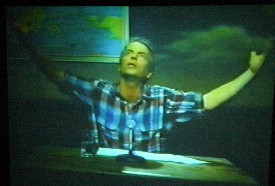 My first exposure to Gray (and to Jonathan Demme) was Swimming to Cambodia, a work that finds Gray seated behind a desk with a glass of water before him, talking and talking and talking about his experiences in Cambodia while filming Roland Joffe’s The Killing Fields. His brief cameo as an ambassador evacuating the embassy is presented here in brief, the only time that we cut away from Gray and his story of doing Thai stick, swimming in the ocean, and wondering what it is that it’s all about. There are signs of doom everywhere in Swimming to Cambodia, the whole thing has an apocalyptic air and when Gray talks about ebbs and flows, Demme rocks his camera back and forth. It’s lulling in the way a cuddle from a madman would be: insidious, menace in the soothing tones of Gray’s carefully-practiced meter and verse. “I’m basically a fearful person. A phobic person” Gray tells us during the course of his spoken-word memoir, and then he tells of leaving his body behind in the shark-infested waters off the coast of where they’re filming, hearing Joffe in his peculiar baritone calling out to him as he drifts farther into the black, and Gray, the phobic person, feels “rocked to terrific sleep.” I watched Swimming to Cambodia often after the death of my own father, looking in my grief for a little of that “perfect moment” I think. Awash with so much of that particular varietal of angry grape, I think for a time that I really understood the blue mood Gray represented.
But the picture itself: Swimming to Cambodia is a masterpiece of the directing and editing arts. It’s as complicated a film as any in Demme’s long and diverse career of showier pictures (Silence of the Lambs, Philadelphia, The Manchurian Candidate and so on), demonstrating of all things that Demme at his best has a deep understanding of his subject matter and uses film as a kind of scalpel to peel back the layers of sign and signifier. Gray was my first exposure to a performer who was his own meta-persona – inseparable from the characters that he played not out of an inability to play something other, but out of too intimate a time spent in his headspace. Demme is the victim, too, of Gray’s invasive neurosis and Swimming to Cambodia is a diary of the passing of a verbal disease. We experience suture with a man in the process of eloquent self-analysis and the danger of that reverse-transference does something to the fabric of the cinema. The screen becomes elastic and we’re formulated to our chairs.
William S. Burroughs called language a virus and Gray provides that naked lunch to midnight word junkies.
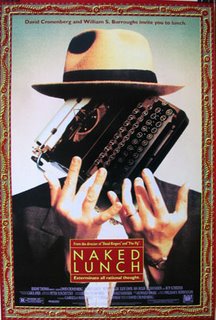 The first time I saw the poster for David Cronenberg’s Naked Lunch, I thought of Spalding Gray. Here: Magritte, there Barton Fink, and everywhere Swimming to Cambodia. While watching Demme’s Neil Young: Heart of Gold, I was reminded of that first of his encounters with mortal thoughts way back in 1987. At PS 122 in the last days of his life, Gray returned to the stage in something incomplete he called “Life Interrupted” – a report of one of his final performances there shows a man who made his living with his liquid wit, befuddled and tormented while an audience of admirers turned impatient, then hostile, before going home. An artist admired for blurring the lines between a public and a personal persona, Gray for me was the artist who blurred the line between subject and audience – he was Herzog before I discovered Herzog – and there’s a line vibrant and true to be drawn between Swimming to Cambodia and Grizzly Man.
So here’s the eulogy, two years late, right on schedule.
Okay, I like the Oscars. It was a special day for me; I made my predictions in all the categories on Oscar.com and kept score throughout the evening (correctly predicting 11 and missing 13). I changed my work schedule to make sure that I had it off. As far as I'm concerned this is my Super Bowl.
Is it fair to compare it to the Super Bowl? I have no interest whatsoever in football. As with religion, football fans are socialized into believing in it; there is nothing intrinsically interesting or valuable about the sport. Still, I wonder how highly it would be valued amongst most sports fans when it's not their team playing in it. The message that I'm getting is that it's not meant for football fans, it's meant to be for a collective mass audience. I skimmed the game and watched the commercials this year and I found myself very deeply depressed what I was seeing. We usually equate the lowest common denominator with the lowbrow, but in studying the commercials and half-time show we realize that the lowest common denominator works desperately to not offend. Their crutch is the shock celebrity gag cameo. I don't know any way that we could justify to any extent something as banal as the Jessica Simpson ad; and I would shudder to meet the hypothetical yokels who found it stimulating.
The Oscars haven't quite gotten that big. I think that there is still the idea that they're catering to a niche audience. It's more compelling television is what I'm saying. I here you protesting, "But Alex, Stewart relied on shock celebrity gag cameos as well in that intro." Quite right, but to much more of a limited extent. And some of those gags, like the one about Steve Martin's kids have a left-of-center absurdity that's missing in what I see during the Super Bowl. There's relatively more freedom here, more of a capacity to alienate. The collective mass audience appeal of the Super Bowl makes me feel lonely, the more limited (movie-loving) mass appeal of the Oscars makes me feel connected.
The passage of time and the maturing of my tastes in film really helped to wean me off the idea that the Oscars are rewarding the best in year's cinema. Really, I think that the three year win of the mediocre films Gladiator, A Beautiful Mind, and Chicago really clenched it for me. I don't take them seriously enough to get mad. I just don't think that they have that much power.
It helps, I guess, that at least one really good film gets nominated every year. Crash actually was my favorite this year, in some way it might have been the only real genre (sci-fi or fantasy) film this year. The musical number, featuring zombies wandering around a burning wasteland of crashed cars, was kind of eerie and wonderful I thought. Love it or hate it, that movie was a work of madness. Not saying that madness necessarily denotes virtue, Tyler Perry's Diary of a Mad Black Woman was a work of madness also and it was one of the worst films of the year.
Anyway...I also liked Brokeback Mountain and Munich. I would have been happy to see them take home more than they did. On average, a Best Picture nominee would earn three stars from me.
Eh...
Crash: ****
Munich: ***1/2
Brokeback Mountain: ***
Good Night and Good Luck: **1/2
Capote: **
The Aviator: ****
Million Dollar Baby: ***
Sideways: ***
Ray: **1/2
Finding Neverland: **1/2
Lost in Translation: ****
Lord of the Rings: Return of the King: ****
Master and Commander: The Far Side of the World: ***1/2
Mystic River: ***
Seabiscuit: *
You know, maybe only one or two of those each year will find their way into my top ten, but I have generally positive feelings toward the kind of cinema that the Academy recognizes. Maybe I’m just a glass half-full kind of guy. I’m not really bothered that Rocky won over Taxi Driver or that The English Patient won over Fargo; I’m genuinely glad that they were nominated and that that is swimming around in our cultural history.
The Chuck Workman montages and the memoriam and the Lifetime Achievement awards, those always electrify me. I feel good about film when I watch that stuff. I like George Clooney, I like Ang Lee, I like Phillip Seymour Hoffman. I like Jon Stewart. Spending three hours with them is a pleasurable experience for me. I guess that this is the long way of saying that it’s not what the Oscars actually award, it’s just the very idea that they exist that there is one night in the year that is devoted to the canonization of the art form.
This was, by the way, a better show than last year. Thank God that they quit that putting the “lesser” nominees on stage as the winner was being announced to save time. Save time for whom exactly?
One of the biggest fund-raising events (maybe the only one outside of the film festival) for the Denver Film Society is a black tie gala thrown in celebration of the Oscars – it’s something that the local news covers to give you an idea about a lot of things – and I mention it because the Oscars are one of those things that anyone who actually cares about movies can only care about in a painful, kitsch-appreciation sort of way. I know that Altman is going to get an honorary Oscar this year – probably Scorsese next year, right? – and I know that that pimp song is going to win for best song even though, subject matter aside (and who gives a shiny shit about that anyway, yes?), it’s just bleeding horrible. It should bug someone that Eminem has more Oscars than Marty, but calling the Academy idiots year-after-year for sixty years inevitably leads to the realization that the real idiots are the ones that don’t stop being chagrined.
So, I’m an idiot.
I think that Crash is going to win best picture – and I think that March of the Penguins will win for best documentary – and I think so because both aren’t just bad like the films nominated with them, but agonizingly bad, and that’s what the middlebrow slurps up with a spoon. Stupid, stupid, stupid – not the middlebrow which are invariably easy to predict and please, but me for still feeling like this relic from my childhood means a thing besides coaxing more of the middlebrow into the theaters tomorrow morning to catch up on the “best” films of the year.
The topic of egregious Oscar injustices is a deep one (I was reminded recently of the My Fair Lady sweep the year of Dr. Strangelove, just another log on the bonfire), and I’m tired of it to be fair – so I find some solace in this year’s stable of nominees in that there’s nothing that I’d root for so even a Crash win would only register as a bad film beating a bunch of mediocre films instead of a bad film beating a decent one in the usual year. Funny how this has been heralded in many corners as the year that Oscar got right. Oscar Night, for cineastes, is fast becoming Valentine’s Day for the lovelorn. This is the first year in more than twenty that I’m not watching it – the first year in five or so that I’m not writing an official piece on it. If I ignore it, it won’t go away, but reading the list in the morning is a lot less soul-sucking than watching the four hours proper.
Here’s hoping that Jon Stewart demonstrates the balls he demonstrated on CNN’s “Crossfire” a while back and calls it likes he sees it.
Finished my Dueling Divas series at the DPL with a screening of What Ever Happened to Baby Jane, Robert Aldrich’s sad, frightening, twisted self-hate fest/freak show. Attendance was healthy and discussion frisky. Next up a “City Streets” series starting with Nimrod Antal’s Kontroll and continuing through stuff like Midnight Cowboy but no Taxi Driver unfortunately: a title that was considered and voted down. Ah well – I’ll get a chance to talk Grave of the Fireflies next month so it’s all good. Also attended a screening of Failure to Launch which is, no kidding, one of the worst movies ever made.
Screenings of Joyeaux Noel and Evil under my belt – and am going to see the new The Hills Have Eyes, the new Dardennes brothers and the new Wim Wenders. Here’s hoping that all or one of them will wash tonight’s results out of my mouth. I did interview Robert Towne this last week in his hotel room as he smoked a thin cigar in a rather mephistophlean way. I didn’t like the film he was stumping. I felt like a wolf. Hopefully a transcript of that and BIFF coverage at long last (Boulder International Film Festival) will materialize before long. Awfully nice to be able to pick and choose who one interviews nowadays.
Here’s this week’s screen capture, easy I think, I'm soul-sick and tired:


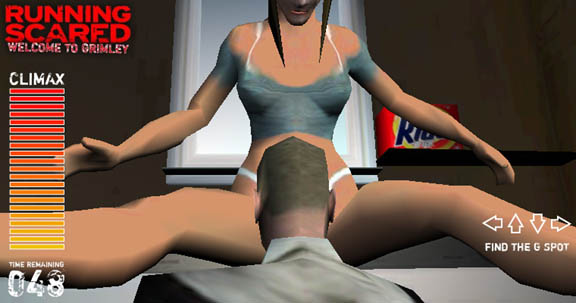
Here you see stills of Atari 2600s "Custer's Revenge" circa 1980 and the recently retired sex game on the website of Running Scared. I ask you friends, is that progress? Twenty five years and it seems that the creators of the Running Scared minigame have made few advancements. I have no idea what the hell that is, but it ain't the female form.
The Running Scared game is chillingly unerotic. First of all; I don't have anything against the act of cunnilinigus per se, but the idea of having the protagonist have to race home to eat out his wife (you can run out of time getting there and thus "fail" at your mission) is powerfully emasculating, reminding of those cuckold stories you read on alt.sex.stories. There is no possible way that the game could be any less threatening. Secondly, the game play is atrocious. The entire game as a whole is really little more but a crummy Grand Theft Auto clone. Load times are painful, controls are jagged, the visuals are blocky. I hesitate to say that porn loses its utility when it's this hard to access as that would rule out the great Ganguro Girl Deluxe where the build up is more titiliating then the payoff, but I can't imagine that driving around in a shitty GTA clone is anybody's idea of foreplay. The actual sex game laughably uses that virtual dancing format where you have to press the right keys at the right time as they drift down your screen. Fatally, when you play the erotic video game in Running Scared you realize how desperate and pathetic you are for playing an erotic video game.
Still, the indignation of conservative media watchdog group National Institute on Media and the Family is enough to set my teeth on edge. I'm an equal opportunity offender mind you, I hate all media watchdog groups-- ADL, NAACP, NOW, GLAAD, CCRL; all those groups trying to regulate the marketplace of ideas. That just seems so adamantly anti-intellectual. Actually, those groups probably piss me off even more. Who the hell knows what a black, a gay, a woman, or even a Catholic or a Jew is anyway? Could the negative portrayals, on some level, reflect or even inform something identifying in the culture? At least you get the impression that the sense of morality that NIMF is protecting is concretely, if somewhat arbitrarily, defined. Eh, I'm going off on a dangerous tangent.
Running Scared the movie, by the way, is kind of hilarious. Just in case you haven't heard already. It would be churlish of me to spoil it's surprises for you, but it's the kind of film that could have only been made by filmmakers with no moral limits and no sense of good taste. I have no idea what my favorite girly-girl Stephanie Zacharek was babbling about when she condemned the film for being self-serious and too high and mighty to give us cheap, sick, thrills for their own sake. I could not detect any message, intended or not, in Running Scared. It's all cheap, sick, thrills for their own sake.
The film is genuinely, and honestly, so bad it's good. They seem to have made it with fairly serious attentions but the thing ran away from them. However I will admit that the pleasures in taking an ironic stance toward it are kind of shallow ones. The film is good for a laugh but it soon evaporates into thin air and that's kind of disturbing for a film with this subject matter. There are degrees of camp and irony and truth be told Running Scared is pretty rudimentary. It's not as sophisticated as Final Destination 3 and that's the one I would recommend you seeing in theaters. On DVD, at the dollar theaters, or premium cable or something you know, you should give this thing a look. I smell cult classic all over it.
To paraphrase Norman Maclean, I am haunted by Perry King. Anyway, you know the drill: be the first to guess which movie the cap below comes from, win a copy of Anchor Bay's new Special Edition of Class of 1984. Contest not open to residents outside North America or, I can't believe I have to say this, people who have already won it. In other news, we may be forced to skip our annual tradition of handicapping the Oscars in a uniquely poor fashion, but consider this a clarion call for your own predictions, rants, et cetera. Having just watched A History of Violence again, I'm pretty furious that Frances McDormand stole Maria Bello's spot in the Supporting Actress category--almost as furious as I am that Charlize Theron took Naomi Watts' place among the Best Actresses. So much for presuming that North Country would quietly disappear just because it's appalling.

 As you may have noticed, some of our DVD reviews have started appearing with an "FFC Must-Own" logo [left] embedded in the text. Apropos of the previous thread, this is an attempt to highlight the crème de la crème of the 1700+ titles we've covered since the dawn of the format, similar to DVD Talk's Collector's Series label. Any DVD containing a four-star film that has scored grades of A- or higher in two of the three tech categories (Image/Sound/Extras) is eligible, and I hope I don't sound like that reductive textbook at the beginning of Dead Poets Society, as by no means do we consider these to be absolute measures of quality. The reason the letter grades were brought into it is to let you know that these particular versions are more or less definitive until the next thing comes along, be it HD-DVD or Blu-Ray or Cronenbergian bioports. I haven't finished going through our archives yet but so far the following DVDs have received a 'must-own' certificate: