Coming soon to a website near you is a review of a wretched Canadian item called Fetching Cody. It's totally undistinguished in the annals of CanCon: lazily name-checked "social issue" (street kids), thoroughly flubbed archetypal resonance (fairy tales), ill-advised attempts at humour (wait for the gay kid who blows his head off), all adding up to one more patient dead on arrival. The amazing thing is not that it came out bad, but that it came out at all.
There was no real reason the movie had to happen. Any half-intelligent person who read the script would know that its head was planted firmly up its ass, and if director David Ray had a highlights reel it would almost certainly have shown him to be tentative and imprecise. Yet the movie got made- and there are scores of movies just like it, from people with the same unformed ideas and the same clumsy execution. One doesn't just get the idea that the system is broken, but that by and large Canadians do not know how to make movies.
The simple truth is that Canadians are unconsciously suspicious of carefully-crafted aesthetics. We're big on annexing those great "social issues," but we're too timid to take the next step and provide a visual/sensual/structural representation of those issues: the mere mention of an important subject is sufficient for a Canuck filmmaker to break out the Dom Perignon and congratulate him/herself for his/her heroism. Doing anything beyond that would somehow seem frivolous: instead of deepening the argument with fine-tuned, well-observed details and an emotional core to give it urgency, we see it all as window-dressing to be discarded.
I have nothing against dealing with big subjects, but then you better not dishonour them. The Dardenne Brothers are a case in point: nobody would accuse them of being frivolous, but their films are extremely careful in how they use the camera and how they sketch the damaged world they depict. You could write papers on the sociological detail, the Christian resonances in The Son and L'enfant, and the strategic use of long traveling shots. The Brothers know their craft, and they use it to give their stories complexity and resonance. But in Canada, all you have to do is show up and they'll pour on the grant money.
The extent of the damage can be measured by the recent, disastrous Stursberg regime at Telefilm. You'll recall that Richard Stursberg was hired to build audiences by greenlighting pop movies- but look at the sorry films that resulted and you'll know that our fear of frivolity had an unusual blowback. We had taught ourselves that the feeling of pop was useless that we taught our filmmakers that a pop film was something that was inherently crappy. That was the unspoken definition, and the results were the crappy films we demanded they be. Say what you like about Michael Bay, but he knows how to shoot and cut to make you feel something. But in Canada, feeling itself is suspect- seriousness rules. And not even seriousness: the name-checking of seriousness, which is perhaps the most deadly frivolity of all.
The rule of mediocrity makes it impossible to establish any kind of organic film culture. On the one hand, there is the fact that most Canadian films die on the table, making it hard to follow truncated careers; on the other is the vast indifference of the Canadian public, which makes attempts to critique the problem all but invisible. The dialogue between filmmakers and critics isn't there- not just because we live in anti-intellectual times, but because everyone is atomized and nobody communicates with anyone else. So directors exist in an intellectual vacuum: nobody pushes them, and the fact that the rest of cinematic Christendom is doing the same lazy things only encourages them- on those rare occasions that they're paying attention.
So I find myself exasperated once again with a situation that keeps getting worse. Canadian filmmakers continue to protect themselves from aesthetic complexity, and there's nobody around to tell them different. Any suggestions on how we could change this?

July 15, 2006


July 11, 2006
Super-fluous
 So yeah, Superman Returns.
 I wanted to see it on the biggest screen that I could, because I never saw any of the Christopher Reeve films theatrically; Superman is one superhero who demands a large canvas, because he can contain the entire globe in his periphery. During the IMAX pre-show at the Paramount in Toronto we were informed that four sequences would be in 3-D, as well as that blinking icons would tell us when to put on our glasses. Fitting that these icons, laser-projected, turned out to be kryptonite-green, as their increasingly-dreaded appearance had a habit of weakening the movie's grip on the audience as people fumbled for their eyewear and giggled at the William Castle corniness of it all.
The first sequence to get the 3-D treatment, a flashback to Clark channelling his inner Peter Pan on the family farm, encapsulates the absurdity of transforming an image photographed for 2-D exhibition into a stereoscopic one: with Clark leaping neither towards nor away from the screen but instead across it, inappropriate emphasis is placed on the crops swaying in the foreground. And so instead of taking some sort of vicarious thrill from this joyous defiance of gravity, you're pushed further into the position of spectator. (This is especially detrimental considering the common complaint about Superman as a character is that it's impossible to put yourself in his shoes.) The 3-D becomes a tool of disengagement.
The airplane rescue, a significant portion of the helicopter climax, and the epilogue are similarly reconfigured for 3-D, which in the case of the first two renders unintelligible what is by most accounts superior montage filmmaking. I've said it before and I'll say it again: HD is not ready to replace 35mm, and the ghosting artifacts introduced in the transfer to celluloid--magnified enough as it is by the blow-up to IMAX--prove an insurmountable gremlin in the conversion to 3-D.
But it wasn't until the final sequence of Supes zigzagging around outer space that I realized why I have felt ripped off by IMAX 3-D, at least when it comes to live-action: rather than give the image more depth, it divides it into planes (which is why it works marginally better for stuff like The Polar Express, since depth in animation is inorganic to begin with), transforming the screen into one of those elaborate Victorian stages with cartoonish water waves on pulleys out front and a glittering sun in back. The irony of adding 3-D to IMAX is that it effectively dwarfs the image by making us hyper-conscious of scale; since it's hard to look simultaneously tangible and larger-than-life, that final solar system tableau evokes nothing so much as a science fair project with styrofoam planets.
Update (7/13)
Word to your mothersite: Walter caps a prolific week with reviews of A Scanner Darkly and the Running Scared DVD, while Travis slogs through all four discs of Chuck Berry: Hail! Hail! Rock 'N' Roll - The Ultimate Collector's Edition.
July 05, 2006
Hughes
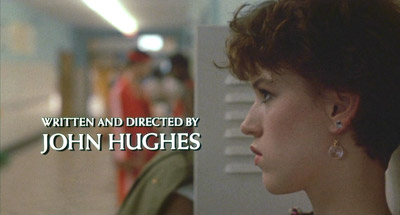 Last week I was interviewed on camera for Don't You Forget About Me, actor Matt Austin's upcoming documentary about the legacy of John Hughes. Now, according to Walter and Alex, I'm a card-carrying Hughes apologist, and I suppose I wouldn't have been inclined to participate if that weren't true, but let's face it: I'm a child of the '80s, and at least part of me did it to be able to say I'm in a movie with fellow interviewee Ally Sheedy.
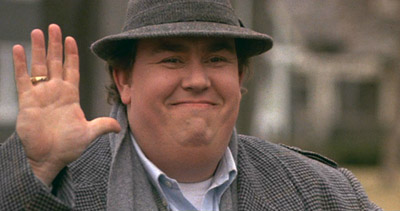
Appearing in the doc also afforded an excuse to watch all of Hughes' movies (i.e. Sixteen Candles, The Breakfast Club, Weird Science, Ferris Bueller's Day Off, She's Having a Baby, Planes, Trains & Automobiles, Uncle Buck, and Curly Sue) consecutively, something I'd wanted to do for a long time. Herewith, five of the many things I learned (or rediscovered) over the course of this task:
1. With one exception, Hughes' movies are a little like William Inge plays...
In that their narratives span a day or two (The Breakfast Club and Ferris Bueller's Day Off flirt with unfolding in real time) and usually centre on a gathering, be it a wedding (Sixteen Candles) or Saturday detention (The Breakfast Club). This suffuses them with a humility honoured by a favouring--almost to the exclusion of plot--of character over message, however political the personal might ultimately be. The aforementioned exception is the joyless She's Having a Baby, which bites off way more than it can chew in going, for argument's sake, from womb-to-tomb instead of dawn-to-dusk. It's one of those crazy-quilt attempts to say everything about men and women that wind up saying nothing at all.
2. John Hughes was the Quentin Tarantino of his day...
In that he loots the pop-culture graveyard for tonal cues diegetic and otherwise. Think of how Hughes alternates the themes from "Peter Gunn" and "Dragnet" for Anthony Michael Hall's "Geek" in Sixteen Candles, or the 2001 and Rocky riffs that open and close, respectively, Weird Science. Like Tarantino, he's also unfairly maligned for the many pretenders to his throne that have cropped up over the years.
3. John Hughes is an artist.
You read vintage reviews of Hughes' pictures--which make them sound like the Rob Schneider vehicles of their day--and you think, What am I missing? Hughes has said that working with veteran cutter Dede Allen on The Breakfast Club was like going to film school, and indeed he became more editorially conscientious thereafter. (Ferris Bueller's Day Off carefully layers rhythms into its blocking.) But there's a shot in Sixteen Candles that shows a prodigious talent, whereby Molly Ringwald is stranded on a bus with Anthony Michael Hall, who's clumsily putting the moves on her: on the opposite side of the frame is a young Joan Cusack doing nothing more than staring off into space--but she's wearing a neck-brace. Because Hughes never leaves the master containing the three of them, the sight of Cusack becomes increasingly absurd and transcendently funny. (It's positively Lynchian.) I think of this TV-unfriendly sight gag, or the Dreyer-esque close-ups of Molly Ringwald during the 'group therapy' sequence of The Breakfast Club, or the detours into Dennis Potter territory in She's Having a Baby (a movie notably edited by Alan Heim, who won an Oscar for Potter contemporary Bob Fosse's All That Jazz), and I can't for the life of me figure out why the phrase "sitcom-style" turns up again and again in criticism of Hughes' oeuvre.
4. The '80s: it was the best of times; it was the worst of times.
With such corporations as Coca-Cola now in charge of the studios, the suits were eager to make not movies, but products, and research/experience told them that their buying public was the youth of America. Along comes Hughes, screenwriter of the popular National Lampoon's Vacation, expressing an interest in tailoring films to the teen demographic--a marketing exec's wet dream. And he proved a mostly responsible ambassador to puberty, eschewing the era's T&A crutch (there's nudity in the PG-rated Sixteen Candles, but it's used to illustrate Molly Ringwald's Carrie White-like inferiority complex) and, by extension, giving teenage girls a point of entry through female characters who weren't simply there to be coveted. (This is really where the Hughes-scripted Pretty in Pink and Some Kind of Wonderful enter the conversation.) Alas, Yellow Peril and homophobia reigned back then, and Hughes was no more immune to it than, say, Steven Spielberg, with the grotesque caricature Long Duk Dong (Gedde Watanabe, the Asian Stepin Fetchit) staining the surprisingly sweet Sixteen Candles like Breakfast at Tiffany's' Mr. Yunioshi. But though Hughes' films are generally lacking in minority representation, he makes up for it by taking a quintessentially Marxist view of high school.
5. John Hughes stopped directing for a reason.
While the "rich" and the "poor" always learn to get along in Hughes' films, there's no question that his allegiance lies with the latter. Consider the quietly devastating passage from Uncle Buck wherein the slovenly, unemployed Buck, flipping through an album at the suburban mansion of his wealthy brother, notices a wedding photo that has been folded to crop Buck out of the picture: Hughes keeps the scene subjective by lingering on the photograph instead of on Buck's reaction, effectively turning sympathy into empathy. But even at that point, his identification with the underclass was starting to seem a little disingenuous, and once you get to Curly Sue, the last film with Hughes at the helm, his portrayal of poverty is downright paternalistic. I firmly believe that a fear of looking like a hypocrite drove him out of the director's chair--you can be Ken Loach or you can be a multi-millionaire (as Hughes had become by crassly exploiting his ability to churn out a screenplay a week).
***
In closing, I'm proud to be a part of this long-overdue project, which is definitely in good hands. My thanks to Matt and producers Kari Hollend and Michael Facciolo for inviting me to take part. You can learn all about Don't You Forget About Me at the film's official website.
Update
Walter's review of Pirates of the Caribbean: Dead Man's Chest is online at last. And if you missed them, check out his piece on the second wave of Anchor Bay's "Masters of Horror" DVDs; Alex's analysis of The Untold Story of Emmett Till; and Travis' take on the clunky cult item Lifespan.
July 03, 2006
The Trench
Fractured thoughts for a fractured week:
- All set to crack wise about how Rob Schneider collapsed on the set of his new film due to some combination of heat stroke and food poisoning and, tragically, survived – what should I read but that Roger Ebert had been rushed to the hospital for emergency surgery to correct complications from his recent cancer procedure, and more, that Argentinian director Fabian Bielinsky had died of heart attack at the ridiculous age of 47. Nothing like a cold bucket of water to soothe the great white snark.
- Let me disclaim that the only thing that I really have against Schneider is that he, like buddy Adam Sandler, are almost single-handedly perpetuating the comic-Asian stereotypes in the mainstream (with assists from the Olsen twins and that idiot who directed Freaky Friday and Mean Girls) – and confess that I liked the first Deuce Bigalow film because of the way that it dealt (not entirely stupid and surprisingly sensitive) with female body image and disability. But that – and the full-page ad he took out in Variety to dimwittedly lambaste one of his critics (Uwe Boll/M. Night Shyamalan/Wayne Kramer-like) – is enough. (What, you think we don’t get pages of hate mail expressing the exact same idiot-think in what's often the same words? How proud you must be.) Oh, that and he’s not funny anymore, his suckling at Sandler’s teat becomes increasingly unseemly, and his The Hot Chick flick functions as an example – perhaps the example – of the theory that film doesn’t exist anymore as a phenomenon that’s not entirely dependent on itself for definition.
- And let me offer that for all that I come down on Mr. Ebert’s inaccuracies and critical condescension – it comes at least in some part from a place of sadness because without Ebert, I never would have gotten started on this path and then from a place of sympathy because I suspect that a lot of what’s been sanding off Ebert’s edge in the last decade or so has to do with his illness and the new lease on life that surviving cancer, so I’ve heard, offers the survivor. If he survives, we’ll blame it again more on other things. But I can’t resist barbing that it doesn’t explain his misogyny (getting more pronounced) – even as it might explain to some extent the venom with which he’s rejected the weaknesses demonstrated by Singer’s version of the Man of Steel.
- But Bielinsky’s death really hurts. I wasn’t a particular fan of Nine Queens (far less its English-language remake Criminal), but I was a big fan of Bielinsky’s. I interviewed him four years ago in Denver and had already made inquiries as to whether I could chat with him again upon the debut at the LA Film Festival of his new film El Aura. Hard to believe it’s been four years between films for him – when we talked, he had a lot of projects in the works, but he’d expressed a great deal of pessimism in regards to the direction in which the Argentinian film industry was headed. The last published line of our interview together haunts me now. I guess those fears were borne out by his absence, and the absence of Argentina as the film power that they seemed poised to become.
But Bielinsky. A bear of a man, we talked off-record and at length about the American ‘70s – I guess he was a film professor and his curricula often included Hackman, Sutherland, Pakula, Coppola – you look at his film and you see the influences but, more, you see them employed with knowledge if a little self-consciousness. His eyes shone when I broached The Conversation with him, if he was guarded a little to start with (battered by a morning and afternoon of journalist dickwads like myself asking him the same retinue of questions), he was warmth personified after. I wanted to recruit Bielinsky for our side because he liked the right things with the right amount of passion and for as frustrating as it can be writing out our words in dark rooms for largely anonymous readers – it can’t have been better butting up against an unsupportive industry shunting you into commercial work. Failing that, I wished for him prolificacy: the ability to tell as many stories as he could before his time was up. Maybe, even better, I hoped that he’d have the time to teach a few more classes so that this movie love of his wouldn’t die from the world. Maybe he did.
I pulled out the tape of our interview and listened to it again. If you’re in the right mood, there’s nothing sadder than the sound of a friend (as much of a friend as you make being one of a hundred, over a tape recorder, and with just one hour alone) you’ll never speak with again clearing his throat.
When we wrapped it up, he gave me his phone number and email which, out of embarrassment, I never used. What an asshole I am. I’ll miss you, Bielinsky – I’m looking forward to the new picture.
- Moderated a screening/discussion of Gregory La Cava’s My Man Godfrey this week and was stricken again by how topical this seventy-year old film has remained. It alternates between screwball (Lombard is the quintessential screwball, of course, and my review of her six-flick set is on the horizon) and serious social commentary with William Powell never better as the titular hobo/butler/savior. The recent Criterion Collection release of the picture blows away my unlicensed transfer – it’s easily worth the upgrade as if there’s any question.
- Found a copy of Huston’s Beat the Devil on DVD in, of all places, the $3.99 bin of my local supermarket. This after my Huston/Bogie series this last Spring in which we couldn’t find an “official” copy of the flick to show. What a shame. Gina Lollabrigida is stunning as always – but my favorite film of hers remains Jules Dassin’s The Law (1959).
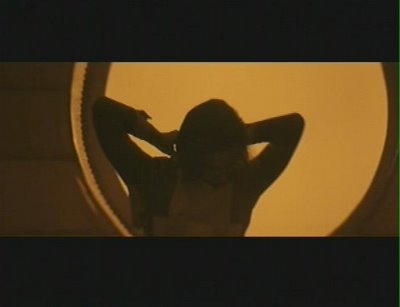
- Gave a two-hour lecture on Stanley Kubrick, tracing his major themes through three keystone films: The Killing, Dr. Strangelove, and 2001: A Space Odyssey. Looking at the latter after Superman Returns revealed a lot to me about Singer’s film. I begin to wonder if Supes isn’t a straight homage – it’s worth considering if the Kryptonian hasn’t been imagined as a spiritual step in our development as a species. If he’s pure moral, then you’ve got to wonder if the picture, like 2001, can’t be divided into quarters. My main source material aside from the films themselves is Michael Ciment’s Kubrick: The Definitive Edition and, as it happens, Alex’s fascinating write-up of 2001.
If I’m ever in the position to do another Kubrick series – I think I’d go with Lolita, The Shining, and Full Metal Jacket.
- Attended a filled screening of Pirates of the Caribbean 2 which left me with two words: Matrix Reloaded. But, err, not as good (?).
- Attended a press screening of Elisha Cuthbert’s The Quiet which left me with one onomatopoeia: ick.
- In other news, got a weekly fifteen-minute gig on the nationally syndicated Bill Press show on Sirius Satellite Radio. 8:45am EST. Tune in if you can – from what I understand, there are potentially 4.3 million listeners out there who might find out about FilmFreakCentral.net through this outlet.
- Hope to get quite a few DVD reviews logged in the next couple of weeks (I know Bill’s hoping so, too) as well as a new opinion piece for the upcoming Annual now that a tighter part of my speaking schedule has come and gone. Among the titles up to bat: Nanny McPhee, Magic, Running Scared, M.A.S.H., and several sci-fi television series including the new BBC “Dr. Who.”
Question of the week: tell me about a promising up-and-comer who either never had a chance to fulfill their potential or, worse, betrayed their debut/s with dud after dud. My first thought of the latter is Michael Lehmann who, after Heathers, began his decline with Meet the Applegates and then Hudson Hawk. Of the former: Steve DeJarnatt who gave us the exceptional Miracle Mile. . . and then what? Also, wherefore art thou Antonia Bird?
Capture:
- All set to crack wise about how Rob Schneider collapsed on the set of his new film due to some combination of heat stroke and food poisoning and, tragically, survived – what should I read but that Roger Ebert had been rushed to the hospital for emergency surgery to correct complications from his recent cancer procedure, and more, that Argentinian director Fabian Bielinsky had died of heart attack at the ridiculous age of 47. Nothing like a cold bucket of water to soothe the great white snark.
- Let me disclaim that the only thing that I really have against Schneider is that he, like buddy Adam Sandler, are almost single-handedly perpetuating the comic-Asian stereotypes in the mainstream (with assists from the Olsen twins and that idiot who directed Freaky Friday and Mean Girls) – and confess that I liked the first Deuce Bigalow film because of the way that it dealt (not entirely stupid and surprisingly sensitive) with female body image and disability. But that – and the full-page ad he took out in Variety to dimwittedly lambaste one of his critics (Uwe Boll/M. Night Shyamalan/Wayne Kramer-like) – is enough. (What, you think we don’t get pages of hate mail expressing the exact same idiot-think in what's often the same words? How proud you must be.) Oh, that and he’s not funny anymore, his suckling at Sandler’s teat becomes increasingly unseemly, and his The Hot Chick flick functions as an example – perhaps the example – of the theory that film doesn’t exist anymore as a phenomenon that’s not entirely dependent on itself for definition.
- And let me offer that for all that I come down on Mr. Ebert’s inaccuracies and critical condescension – it comes at least in some part from a place of sadness because without Ebert, I never would have gotten started on this path and then from a place of sympathy because I suspect that a lot of what’s been sanding off Ebert’s edge in the last decade or so has to do with his illness and the new lease on life that surviving cancer, so I’ve heard, offers the survivor. If he survives, we’ll blame it again more on other things. But I can’t resist barbing that it doesn’t explain his misogyny (getting more pronounced) – even as it might explain to some extent the venom with which he’s rejected the weaknesses demonstrated by Singer’s version of the Man of Steel.
- But Bielinsky’s death really hurts. I wasn’t a particular fan of Nine Queens (far less its English-language remake Criminal), but I was a big fan of Bielinsky’s. I interviewed him four years ago in Denver and had already made inquiries as to whether I could chat with him again upon the debut at the LA Film Festival of his new film El Aura. Hard to believe it’s been four years between films for him – when we talked, he had a lot of projects in the works, but he’d expressed a great deal of pessimism in regards to the direction in which the Argentinian film industry was headed. The last published line of our interview together haunts me now. I guess those fears were borne out by his absence, and the absence of Argentina as the film power that they seemed poised to become.
But Bielinsky. A bear of a man, we talked off-record and at length about the American ‘70s – I guess he was a film professor and his curricula often included Hackman, Sutherland, Pakula, Coppola – you look at his film and you see the influences but, more, you see them employed with knowledge if a little self-consciousness. His eyes shone when I broached The Conversation with him, if he was guarded a little to start with (battered by a morning and afternoon of journalist dickwads like myself asking him the same retinue of questions), he was warmth personified after. I wanted to recruit Bielinsky for our side because he liked the right things with the right amount of passion and for as frustrating as it can be writing out our words in dark rooms for largely anonymous readers – it can’t have been better butting up against an unsupportive industry shunting you into commercial work. Failing that, I wished for him prolificacy: the ability to tell as many stories as he could before his time was up. Maybe, even better, I hoped that he’d have the time to teach a few more classes so that this movie love of his wouldn’t die from the world. Maybe he did.
I pulled out the tape of our interview and listened to it again. If you’re in the right mood, there’s nothing sadder than the sound of a friend (as much of a friend as you make being one of a hundred, over a tape recorder, and with just one hour alone) you’ll never speak with again clearing his throat.
When we wrapped it up, he gave me his phone number and email which, out of embarrassment, I never used. What an asshole I am. I’ll miss you, Bielinsky – I’m looking forward to the new picture.
- Moderated a screening/discussion of Gregory La Cava’s My Man Godfrey this week and was stricken again by how topical this seventy-year old film has remained. It alternates between screwball (Lombard is the quintessential screwball, of course, and my review of her six-flick set is on the horizon) and serious social commentary with William Powell never better as the titular hobo/butler/savior. The recent Criterion Collection release of the picture blows away my unlicensed transfer – it’s easily worth the upgrade as if there’s any question.
- Found a copy of Huston’s Beat the Devil on DVD in, of all places, the $3.99 bin of my local supermarket. This after my Huston/Bogie series this last Spring in which we couldn’t find an “official” copy of the flick to show. What a shame. Gina Lollabrigida is stunning as always – but my favorite film of hers remains Jules Dassin’s The Law (1959).
- Gave a two-hour lecture on Stanley Kubrick, tracing his major themes through three keystone films: The Killing, Dr. Strangelove, and 2001: A Space Odyssey. Looking at the latter after Superman Returns revealed a lot to me about Singer’s film. I begin to wonder if Supes isn’t a straight homage – it’s worth considering if the Kryptonian hasn’t been imagined as a spiritual step in our development as a species. If he’s pure moral, then you’ve got to wonder if the picture, like 2001, can’t be divided into quarters. My main source material aside from the films themselves is Michael Ciment’s Kubrick: The Definitive Edition and, as it happens, Alex’s fascinating write-up of 2001.
If I’m ever in the position to do another Kubrick series – I think I’d go with Lolita, The Shining, and Full Metal Jacket.
- Attended a filled screening of Pirates of the Caribbean 2 which left me with two words: Matrix Reloaded. But, err, not as good (?).
- Attended a press screening of Elisha Cuthbert’s The Quiet which left me with one onomatopoeia: ick.
- In other news, got a weekly fifteen-minute gig on the nationally syndicated Bill Press show on Sirius Satellite Radio. 8:45am EST. Tune in if you can – from what I understand, there are potentially 4.3 million listeners out there who might find out about FilmFreakCentral.net through this outlet.
- Hope to get quite a few DVD reviews logged in the next couple of weeks (I know Bill’s hoping so, too) as well as a new opinion piece for the upcoming Annual now that a tighter part of my speaking schedule has come and gone. Among the titles up to bat: Nanny McPhee, Magic, Running Scared, M.A.S.H., and several sci-fi television series including the new BBC “Dr. Who.”
Question of the week: tell me about a promising up-and-comer who either never had a chance to fulfill their potential or, worse, betrayed their debut/s with dud after dud. My first thought of the latter is Michael Lehmann who, after Heathers, began his decline with Meet the Applegates and then Hudson Hawk. Of the former: Steve DeJarnatt who gave us the exceptional Miracle Mile. . . and then what? Also, wherefore art thou Antonia Bird?
Capture:
June 29, 2006
Book In Progress
 So, this is the revised art for our upcoming Annual. You like? Lodge Kerrigan, Steven Soderbergh, and the folks at Magnolia Pictures recently gave us their blessing to pay tribute to Keane's indelible one-sheet; this was the first cover concept that I felt captured the ineffable flavour of a year that was ultimately bittersweet for us and cinema in general.
We're aiming to have the book available for purchase by August 15th. There's more exclusive content this time around, including previously-unpublished reviews of 9 Songs, Prozac Nation, L'Intrus, and The Future of Food. Circle the date and save your pennies--but in the meantime, if you have any last-minute suggestions, speak now or forever hold your peace.
And don't forget, the 2005 edition is still on sale. (See our main page for a list of retailers.)
Last but not least, in case you missed them, reviews of The Devil Wears Prada, Eraserhead/The Short Films of David Lynch/Dumbland, and Valley of the Dolls are now live at the mothersite.
June 24, 2006
The Trench
Long, eventful week as a lot of threads came together. My coverage of the Denver Film Society’s Asian Film Festival, at least for me, closed the circle a little on the unpleasantness between myself and that organization that began with my criticism of their International Film Festival on these very pages (culminating in some sad back-and-forths between friends at the Society) – it’s not closure, exactly, but a feeling that at least for my part, I want to get on with a professional working relationship even if personal relationships can’t be salvaged.
The Asian Fest is awesome even if the films I saw weren’t all keepers. It stinks of honest intentions and that’s increasingly a rare and valuable commodity.
On a panel a few months ago at the Vail Film Festival, I was asked if it was difficult or, truly, even possible to separate myself from the people that I worked with in the industry – and of how those relationships shaped my opinions and criticisms. If you’re human with reasonable social skills, you make friends along any road you take and no less so this one. You try to maintain objectivity but sometimes you just have to take a pass. At FFC, the unofficial best practice has always been that I log a review before I go to interview someone for the first time, thus leaving the review untainted (for good or bad) by my personal impressions of the makers.
It works out fine most of the time – particularly since I stopped just taking interviews with anyone who came to town – but there were a couple of times (Peter Hedges, for instance, who I hit it off with well enough so that when he read my ambivalent-hostile review of Pieces of April, he fired off an angry and hurt missive to the studio requesting, among other things, that I not be allowed access when I was to discuss his film at a public screening) where me not being an asshole to someone resulted in some confusion, on their part, as to what my role actually is in this relationship. Film’s are personal things, and not just for their creators, so personal in fact, that they’re almost like psychic babies.
As to the confusion, though: join the club. The role of film critic in this society is muddy beyond muddy and not for the reasons of “what is quality” that we’ve already worked over like a tasty bit of gristle we just can’t bring ourselves to spit out. As Bill linked below, director Wayne Kramer’s (and his frantically sycophantic interviewer’s) agreement that critics should have no opinion nor personal bias but, rather, be publicists for the film, is a tiresome and troubling thing. (Even though his film, Running Scared is one that I like and will be reviewing in a few days.) More than the words of some pinhead who can’t take a hit, though, is the plain fact that the majority of people believe that critics should be objective reporters and, even more perverse, that good critics ever are. The fallacy of our news media, in fact, is this illusion of objectivity – far better to know where the writer stands than to have the reporter pretend not to have a stance at all.
It brings me to more news: a documentary series has been greenlit by the Denver Public Library for this August with me at the helm – the first time I’ve had so much say in a program offered by this branch. The lineup: Keep the River on Your Right, Rivers and Tides, Brother’s Keeper, Bright Leaves, and Hybrid and I’m excited as hell to dive into the mix. If you’re in Denver in a couple of months, it’s going to be a fun ride.
Also upcoming, a single night wherein I get to show my Laserdisc of Fearless at the Gilpin County Library.
Saw Superman Returns at a closed screening and cried through a lot of it. Saw Click at a regular matinee and, ditto, though not for the same reasons. Have a screener of Sympathy for Lady Vengeance that’s burning a hole in the back of my head; watched Underworld: Evolution and. . . really liked it; watched Aeon Flux and. . . really didn’t; and watched Cat on a Hot Tin Roof three times back-to-back-to-back one late, late night because it’s actually just that good. In a roundabout way, it spurs the question of the F/X moments in film that you found to have the most positive impact in terms of atmosphere, story, even character development. For me, I still love the giant cardboard ball from Raiders of the Lost Ark, the first kill in Hooper's The Texas Chain Saw Massacre, the tractor beam matte and dual suns in Star Wars, Vermithrax Pejorative in Dragonslayer, and the genius-level splatter in John Carpenter's The Thing and David Cronenberg's The Fly.
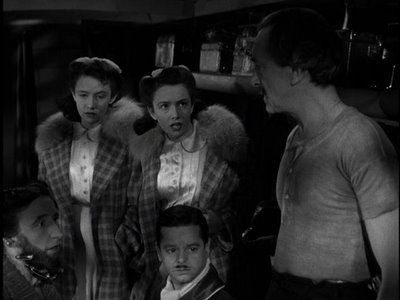
Hosted a screening/discussion of Howard Hawks’ Ball of Fire, speaking of underseen/ill-revived: the story of a stuffy professor (Gary Cooper) who finds love in the arms of a tough-talking dame (Barbara Stanwyck). It’s an inversion of the Snow White myth (and Disney’s Snow White and the Seven Dwarves can be seen on a theater marquee in one brief background), and an inversion of the Pygmalian myth, too. Shot by Greg Toland (the year he did Citizen Kane) and written by Billy Wilder & Charles Brackett as their last assignment as just a writing team (Wilder sat on the set to observe Hawks’ style during the shoot as a kind of training camp), it’s a collision of legends in one of the great years (1941) in Hollywood history. Doesn’t make it a masterpiece, but it ain’t chopped liver, sister.
Here’s this week’s screen capture (I’ll tally the totals next time around):
Hot off the presses (62606)
Superman Returns
and Cat on a Hot Tin Roof
and Alex rides wild ORCA
The Asian Fest is awesome even if the films I saw weren’t all keepers. It stinks of honest intentions and that’s increasingly a rare and valuable commodity.
On a panel a few months ago at the Vail Film Festival, I was asked if it was difficult or, truly, even possible to separate myself from the people that I worked with in the industry – and of how those relationships shaped my opinions and criticisms. If you’re human with reasonable social skills, you make friends along any road you take and no less so this one. You try to maintain objectivity but sometimes you just have to take a pass. At FFC, the unofficial best practice has always been that I log a review before I go to interview someone for the first time, thus leaving the review untainted (for good or bad) by my personal impressions of the makers.
It works out fine most of the time – particularly since I stopped just taking interviews with anyone who came to town – but there were a couple of times (Peter Hedges, for instance, who I hit it off with well enough so that when he read my ambivalent-hostile review of Pieces of April, he fired off an angry and hurt missive to the studio requesting, among other things, that I not be allowed access when I was to discuss his film at a public screening) where me not being an asshole to someone resulted in some confusion, on their part, as to what my role actually is in this relationship. Film’s are personal things, and not just for their creators, so personal in fact, that they’re almost like psychic babies.
As to the confusion, though: join the club. The role of film critic in this society is muddy beyond muddy and not for the reasons of “what is quality” that we’ve already worked over like a tasty bit of gristle we just can’t bring ourselves to spit out. As Bill linked below, director Wayne Kramer’s (and his frantically sycophantic interviewer’s) agreement that critics should have no opinion nor personal bias but, rather, be publicists for the film, is a tiresome and troubling thing. (Even though his film, Running Scared is one that I like and will be reviewing in a few days.) More than the words of some pinhead who can’t take a hit, though, is the plain fact that the majority of people believe that critics should be objective reporters and, even more perverse, that good critics ever are. The fallacy of our news media, in fact, is this illusion of objectivity – far better to know where the writer stands than to have the reporter pretend not to have a stance at all.
It brings me to more news: a documentary series has been greenlit by the Denver Public Library for this August with me at the helm – the first time I’ve had so much say in a program offered by this branch. The lineup: Keep the River on Your Right, Rivers and Tides, Brother’s Keeper, Bright Leaves, and Hybrid and I’m excited as hell to dive into the mix. If you’re in Denver in a couple of months, it’s going to be a fun ride.
Also upcoming, a single night wherein I get to show my Laserdisc of Fearless at the Gilpin County Library.
Saw Superman Returns at a closed screening and cried through a lot of it. Saw Click at a regular matinee and, ditto, though not for the same reasons. Have a screener of Sympathy for Lady Vengeance that’s burning a hole in the back of my head; watched Underworld: Evolution and. . . really liked it; watched Aeon Flux and. . . really didn’t; and watched Cat on a Hot Tin Roof three times back-to-back-to-back one late, late night because it’s actually just that good. In a roundabout way, it spurs the question of the F/X moments in film that you found to have the most positive impact in terms of atmosphere, story, even character development. For me, I still love the giant cardboard ball from Raiders of the Lost Ark, the first kill in Hooper's The Texas Chain Saw Massacre, the tractor beam matte and dual suns in Star Wars, Vermithrax Pejorative in Dragonslayer, and the genius-level splatter in John Carpenter's The Thing and David Cronenberg's The Fly.
Hosted a screening/discussion of Howard Hawks’ Ball of Fire, speaking of underseen/ill-revived: the story of a stuffy professor (Gary Cooper) who finds love in the arms of a tough-talking dame (Barbara Stanwyck). It’s an inversion of the Snow White myth (and Disney’s Snow White and the Seven Dwarves can be seen on a theater marquee in one brief background), and an inversion of the Pygmalian myth, too. Shot by Greg Toland (the year he did Citizen Kane) and written by Billy Wilder & Charles Brackett as their last assignment as just a writing team (Wilder sat on the set to observe Hawks’ style during the shoot as a kind of training camp), it’s a collision of legends in one of the great years (1941) in Hollywood history. Doesn’t make it a masterpiece, but it ain’t chopped liver, sister.
Here’s this week’s screen capture (I’ll tally the totals next time around):
Hot off the presses (62606)
Superman Returns
and Cat on a Hot Tin Roof
and Alex rides wild ORCA
June 23, 2006
The Most Uneventful 100th Post Ever
 Sorry for the radio silence on FFC's end this week. Speaking for myself, I've been toiling away on the book, putting the finishing touches on an upcoming David Lynch omnibus, and re-watching the entire John Hughes canon for reasons to be elaborated upon at a later date.
But it's business-as-usual at the mother site, with Walter's coverage of this year's Aurora Asian Film Festival finally going live, Tennesse Tuesdays continuing apace, and Travis slaying Click.
Off-site, everyone's buzzing about THE ONION A.V. CLUB's recent list of "Classic Movies It's Okay to Hate." Some truly sacred cows tipped therein, though nothing that sent my blood pressure through the roof. I hope this becomes a recurring feature there, otherwise we might just have to steal the idea--not that the designated classics have ever had a free ride at FILM FREAK CENTRAL.
Aw hell, let's steal the idea informally: what piece of IMDb Top 250 bait can you just not get behind?
Subscribe to:
Posts (Atom)